
What kind of Europe do younger generations want to build? And what happens when young people from across Central and South-East Europe are given the opportunity not only to discuss its future, but to shape concrete ideas together?
These questions were at the heart of the SEE Youth Forum 2026, held on 14 September at MIB Trieste School of Management. Promoted by the SEE Observatory, the Forum brought together young people from across the region, alongside professors and experts, for a participatory workshop focused on some of Europe’s key challenges: democratic participation, dialogue, peace and security, sustainability, freedom of expression and regional cooperation.
Rather than being simply a space for discussion, the Youth Forum was conceived as a laboratory of ideas. Guided by Irena Topalli, an expert in civil society and youth policies, participants worked in groups, comparing experiences and perspectives from their respective countries to identify shared priorities and develop proposals for the future of Europe and regional cooperation. Their contributions will help shape the themes and activities of the Liberal Dialogues 2027.
The Forum brought together participants from Italy and from all the countries within the SEE Observatory’s area of interest, alongside a delegation of students from UWC Adriatic, creating a genuinely regional space for exchange between different experiences and perspectives.
Among the participants were the five winners of the SEE Observatory international call “How to Build the Europe I Would Like”: Draga Gajić from Bosnia and Herzegovina, Tea Radunović from Montenegro, Algert Bici from Albania, Marina Cossu from Italy and Jana Djudjic from Serbia.
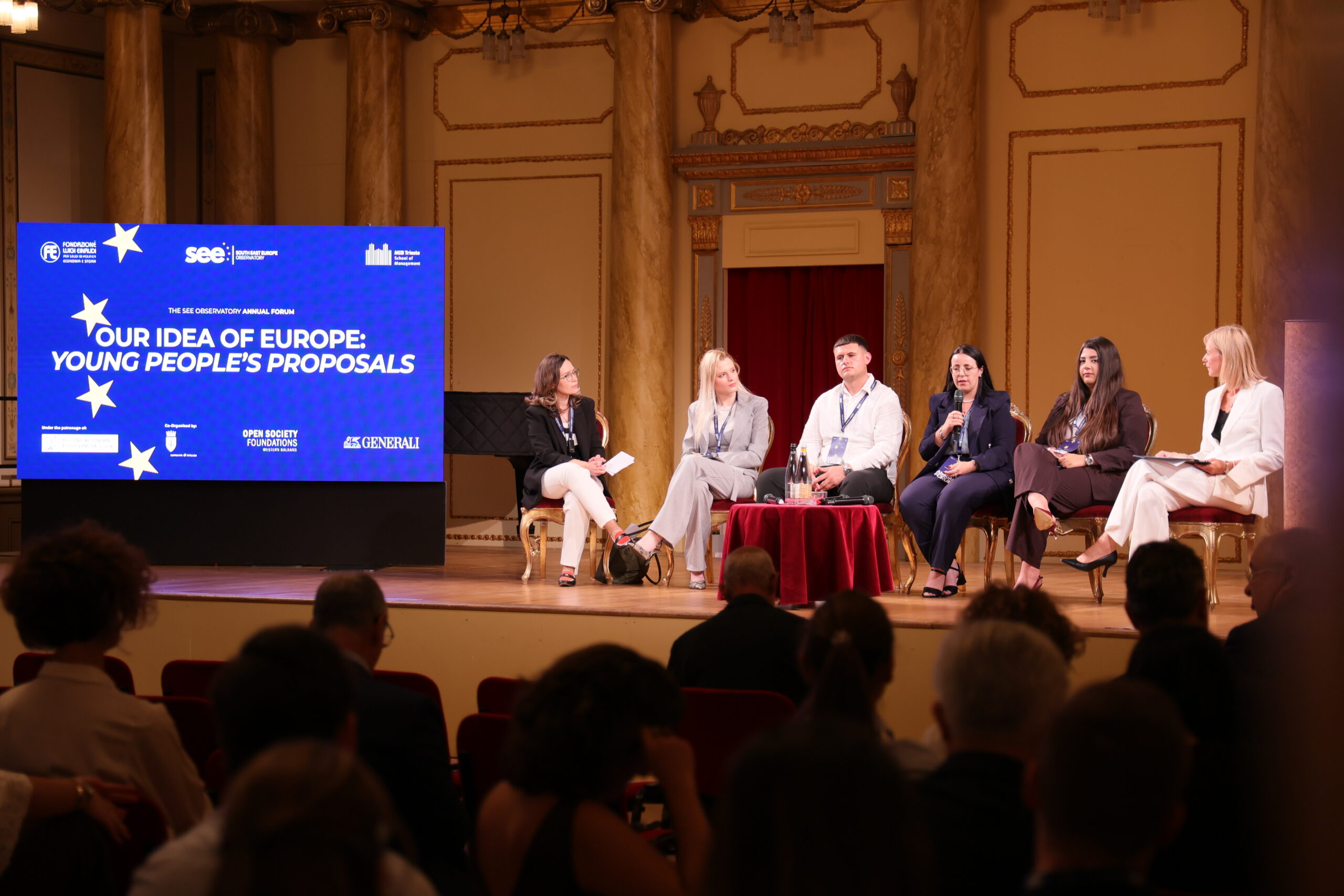
The Youth Forum was not an isolated event. The ideas developed on 14 September were brought into the institutional conversation the following day, when the SEE Observatory Annual Forum gathered young people, policymakers and institutional representatives at Trieste’s Ridotto del Teatro Verdi. There, the five young participants received their €1,000 scholarships and shared their reflections on Europe in the context of a high-level discussion attended by, among others, Antonio Tajani, Deputy Prime Minister and Minister of Foreign Affairs and International Cooperation of Italy, and Ervin Ibrahimović, Deputy Prime Minister and Minister of Foreign Affairs of Montenegro.
Watch the full SEE Observatory Annual Forum here!
Five Voices, One European Conversation
Different backgrounds and perspectives converged around common priorities: peace, trust, participation and the need to make young people active contributors to the European project.
For Draga Gajić, who recalled growing up in Banja Luka and reflected on the impact of war on her family history, peace cannot be taken for granted. “We all need to work on peace and build peace, because peace is not given,” she said. Dialogue, tolerance and individual responsibility are therefore essential, particularly at a time when democracy and liberal values are facing growing pressure. After meeting and working with the young participants in Trieste, her conclusion was one of confidence: “Europe is in good hands.”
Tea Radunović invited the audience to imagine Europe “through children’s eyes”: a Europe capable of preserving dreams and hopes, but also of questioning what is wrong rather than simply accepting it. “Why does it have to be this way?” she asked, calling for a Europe that pays greater attention to people, opportunities and future generations.
For Algert Bici, Europe should be more than a union of countries. It should be a community where young people can have equal opportunities regardless of where they come from, built on solidarity, cooperation and respect, and able to combine innovation with democracy.
The value of dialogue emerged strongly from Marina Cossu’s experience. Meeting young people from the Western Balkans and hearing how they look at the European Union with hope changed her own perspective. The exchange showed how bringing together people with different experiences can challenge assumptions and strengthen a shared sense of European belonging.
Jana Djudjic focused on another crucial issue: the distance between young people and institutions. Her call was to bring younger generations “into the heart of institutions”, creating spaces where they can understand European processes, participate and recognise the value of their contribution. Her final message captured the spirit of the discussion: “Never forget that your voice is our Europe.”
From Trieste to the Liberal Dialogues 2027
From the collaborative work of the Youth Forum to the stage of the Annual Forum, the two days in Trieste offered a common message: Europe’s future cannot be discussed without the generations that will live it.
For the SEE Observatory, their ideas are not intended to remain within the Forum. They will become part of the work leading towards the Liberal Dialogues 2027, continuing a process designed to turn dialogue between young Europeans into participation, cooperation and concrete proposals for the future of the continent.