

Iceland’s ‘no’ to reopening negotiations shows that joining the EU is no longer a foregone conclusion. As Brussels drags its feet, Russia, China, Turkey, and the US are vying for influence, investments and security in the Balkans.
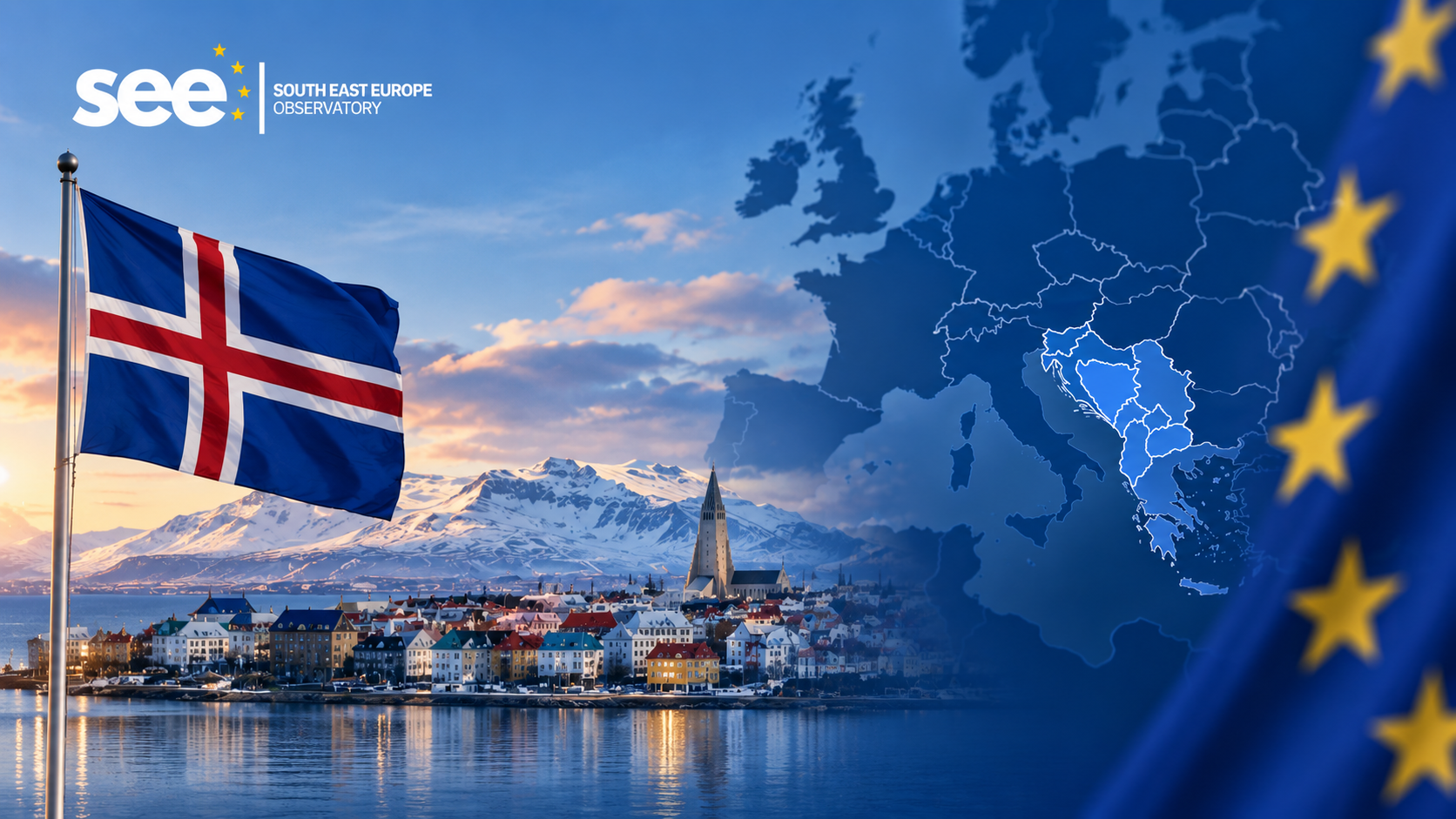
The outcome of the Icelandic referendum – with 52.8% of voters rejecting the resumption of European Union accession negotiations—does not represent a mere episode of Nordic folklore, nor a technical dispute over the exploitation of fishing quotas in the North Atlantic. Rather, it constitutes a political-constitutional earthquake of systemic magnitude, capable of exposing the obsolescence of international constraints in the contemporary multipolar context. The vote in Reykjavik certifies an inconvenient truth that European chancelleries prefer to ignore: membership in the European Union is no longer perceived as an inevitable and unavoidable historical destiny, but rather as a bureaucratic and regulatory cost that certain peripheral partners deliberately choose not to bear.
The decision of the small Arctic Republic must be interpreted as an exercise of cold, calculating functional realism, matured in a global environment where security has been structurally decoupled from political integration. Iceland conducted an extreme pragmatic cost-benefit analysis: its military deterrence and the physical protection of its territory are already fully guaranteed by the Atlantic Alliance, while access to the single market is secured through its participation in the European Economic Area. Within such a framework, ceding significant portions of national sovereignty and decision-making autonomy to Brussels to obtain a marginal “plus” compared to the status quo was deemed a disadvantageous bargain. The classic “European package” – which inextricably links legislative harmonization, market access, and political conditionality – has been unbundled and rejected.
This conceptual short-circuit carries disruptive implications for the European Union’s action in its southern quadrant, exposing the structural fragilities of the enlargement process toward the Western Balkans. For over two decades, Brussels has managed its geographical neighbourhood through a purely technical-bureaucratic approach, treating accession as an endless maturity exam. The ritual has remained identical and static: thirty-five negotiating chapters to open and close, a dense constellation of technical and judicial benchmarks to tick off, annual assessments conducted by a Commission perceived as a cold and distant judge, and finally, a verdict demanding the political unanimity of the EU-27. This practice has been founded on an unshakable, fideistic conviction: the idea that the intrinsic attractiveness of the EU model and the transformative power of its rules were self-sufficient magnetic forces, capable on their own of inducing democratic convergence and lasting reforms.
The contrast between Iceland and the Balkan peninsula reveals the trap of this framework. While the Arctic island can afford the luxury of refusal due to its democratic stability and geostrategic position, the countries of the Western Balkans are fragile, exposed realities contiguous to the European Union. Yet, the political elites of the Region have drawn the exact same conclusion as Icelandic voters: formal accession to Brussels is no longer the only game in town. Rather than accelerating along the path of reforms, opportunistic and illiberal leaderships have understood how to politically monetise a state of permanent transition, transforming it into a lucrative geopolitical rent. Exploiting European procedural delays as an alibi, these ruling classes play simultaneously at multiple tables within a highly competitive alliance market. They negotiate opaque infrastructural investments with China, tolerate Russian interference and energy blackmail, open security channels with Turkey, and forge informal axes of cooperation with Trump-aligned conservative networks. They cash in on immediate resources without having to submit to any democratic or rule-of-law conditionalities.
The Union’s failure lies in its obstinacy in defending the Monnet Method, a model designed for an era of slow, linear, and predictable peace – for a world in which cohesion could gradually radiate from the bureaucratic center toward the periphery. Today, history is running in the opposite direction. Faced with asymmetric threats and Russia’s hybrid warfare, it is the periphery that behaves as the true Europe, while the decision-making center remains paralysed by its own political hesitations and opportunistic vetoes. Ukraine proves this: on the battlefield, its army has fused heterogeneous Western military technologies into a single digital defense system, becoming the operational vanguard of a common European defense that Brussels has yet to even theorise.
The unspoken truth hovering in the corridors of the Berlaymont is that the Union’s current, fragile stability rests not on integration, but on calculated, strategic exclusion. Keeping the Western Balkans locked in an eternal waiting room has become the daily institutional sedative for Brussels. This permanent buffer zone serves a weak Europe by allowing it to offload its own crises – starting with Italian migration policies and the failed centers of Shengjin and Gjadër in Albania – without granting these countries a seat in the Council, which would alter internal political balances and force a reform of the unanimity rule. The acquis communautaire no longer acts as an ideal horizon, but as a mental bunker erected to defend a sclerotic status quo.
The consequences of this political vacuum are evident and dangerous. To avert the collapse of its own security, the European Union must abandon the binary logic of all-or-nothing and adopt the posture of a geopolitical power. Today, the Eastern frontier stretching from Tirana to Kyiv represents the new limes of the West. If Brussels continues to take refuge in the swamp of its own regulations, someone else will write the rules of continental security in its place. To avoid condemning itself to sclerosis, Europe must have the courage to transform its bureaucracy into politics, offering real protection and safeguards today, lest it be subjected to the force of tomorrow’s autocrats.
The original article in Italian by Gianluca Eramo was published on Linkiesta at the following link: www.linkiesta.it