
One of the central contributions of the first SEE Observatory Annual Forum, held on 15 September at the Ridotto del Teatro Verdi in Trieste, was the presentation of the SEE Observatory Charter. Presented by Ambassador Luigi Mattiolo, Honorary President of the SEE Observatory, the Charter outlines a progressive approach to Western Balkan integration.
Its central idea is that, as candidate countries implement reforms and make verified progress in specific sectors, they should be able to gradually experience some of the benefits associated with EU membership before full accession.
This approach is not presented as an alternative to full membership. Rather, it seeks to make the integration process more credible and predictable by linking concrete progress to tangible benefits along the way.
Presenting the Charter, Mattiolo placed Western Balkan integration within a broader international context. In an increasingly fragmented and polarised world, he argued, completing Europe’s integration, including the Western Balkans, has become a strategic interest for the continent.
Italy and Montenegro in Dialogue on Western Balkan Integration
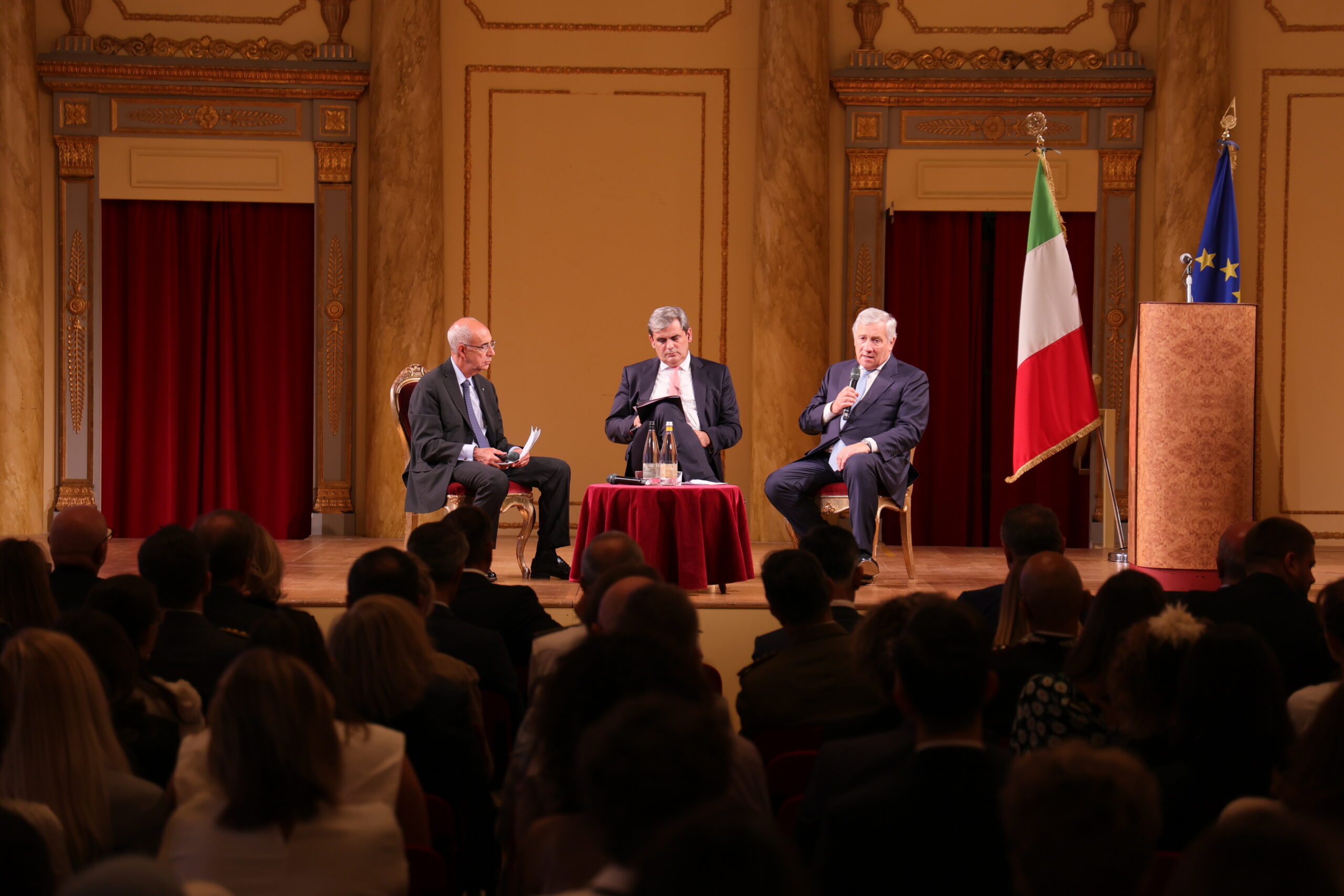
The proposal became part of the institutional discussion during the Interactive Dialogue “Accelerating Western Balkans Integration as a Strategic Choice for Europe’s Future”, moderated by Ambassador Luigi Mattiolo, with the participation of Antonio Tajani, Vice President of the Council of Ministers and Minister of Foreign Affairs and International Cooperation of Italy, and Ervin Ibrahimović, Deputy Prime Minister for International Relations and Minister of Foreign Affairs of Montenegro.
Ibrahimović highlighted Montenegro’s commitment to its European path and the importance of a merit-based approach, linking progress towards membership to reforms and continued cooperation with European partners. He reiterated Montenegro’s ambition to complete negotiations by 2026 and work towards EU membership in 2028.
Tajani called for a change in the way the process itself is described. Rather than speaking only of EU “enlargement”, he proposed the concept of European “reunification”, stressing that the Western Balkan countries are European countries and that their integration is part of completing the European project.
At the same time, he emphasised that rigorous procedures should not become an obstacle to political progress and argued that the process should not be weakened by excessive bureaucracy or continued delays.
Towards the end of the dialogue, the discussion returned directly to the proposal presented by the SEE Observatory. Tajani expressed appreciation for the Observatory’s contribution and for the idea of a less bureaucratic model of integration, expressing support for an approach capable of providing candidate countries with concrete benefits as they make verified progress towards membership.
The exchange gave the SEE Observatory Charter a direct place within the wider political discussion of the Forum.
Security, economy and connectivity
Security was closely linked to the discussion. Ibrahimović stressed that the security of the Western Balkans and the security of Europe are closely interconnected, while Tajani placed the region within the wider debate on European security and defence.
The dialogue also explored the economic dimension of integration.
Ibrahimović highlighted the relationship between Montenegro and Italy and pointed to energy, renewable sources, education, research, entrepreneurship and investment as areas where closer cooperation can already generate concrete opportunities. The electricity interconnection between Italy and Montenegro was also recalled as an example of existing links between the two countries.
Tajani similarly connected Western Balkan integration with the creation of a larger and stronger European market, highlighting the opportunities that closer economic integration could create for trade, investment, tourism and the movement of people.
Connectivity was another important element of the discussion. The strategic position of Trieste and the Upper Adriatic, together with links towards the Western Balkans and Central Europe, was considered within the broader development of international transport and trade corridors.
Across the discussion, integration therefore emerged not only as an institutional process, but as one that also develops through economic relations, energy, infrastructure and direct connections between countries and people.
With the presentation of the Charter, the SEE Observatory brought its proposal into this wider institutional debate: linking verified progress towards EU membership with tangible benefits along the way, while maintaining full accession as the final objective.