


An article by Tatjana Đorđević, journalist and expert on the Western Balkans, for SEE Observatory.
The student-backed movement has brought an end to fourteen years of political dominance by Aleksandar Vučić. But its historic electoral victory raises a more difficult question: can Serbia dismantle the system that sustained his power and build a functioning democracy?
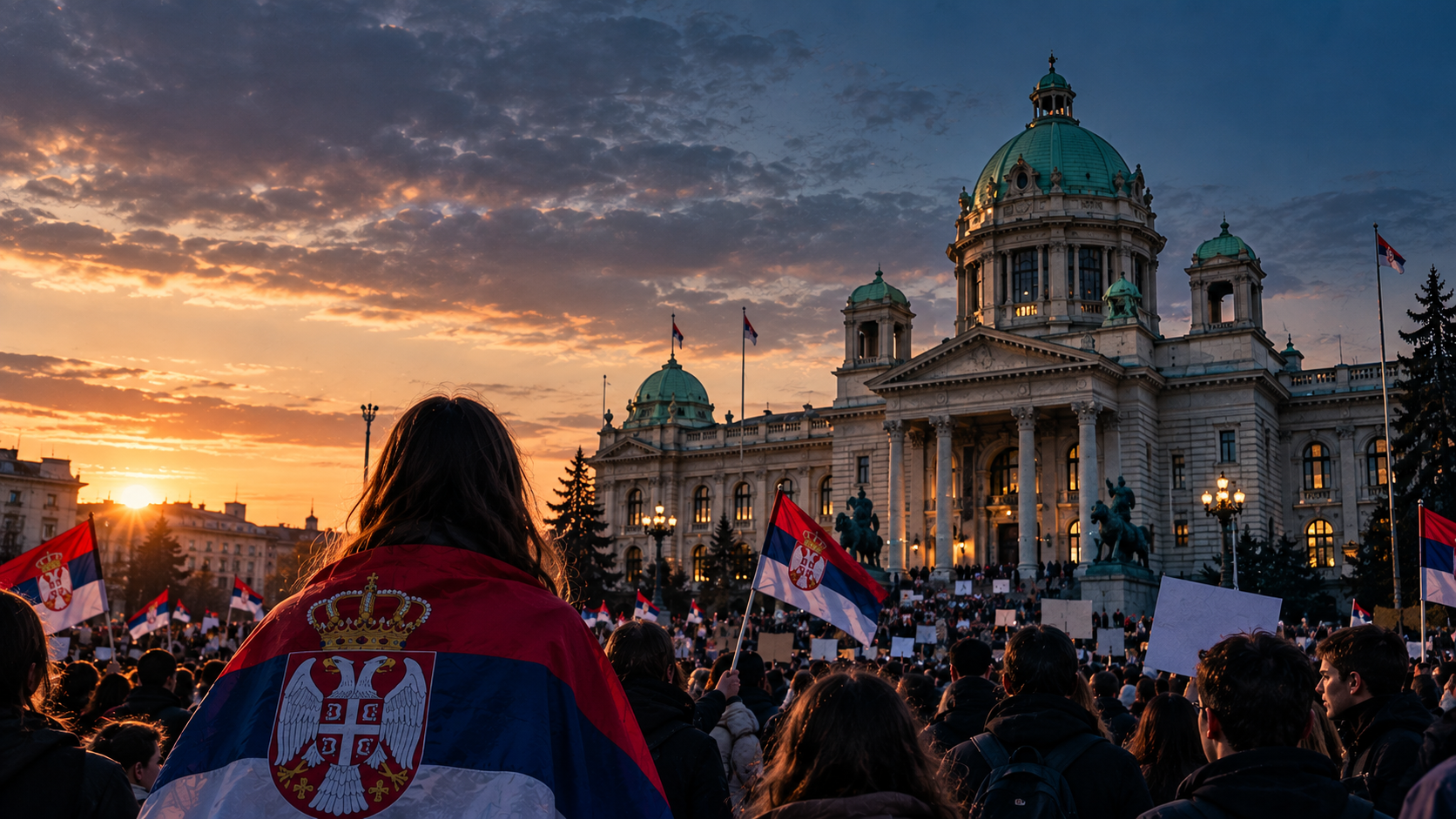
After almost two years of student-led protests, political confrontations and mounting tensions, many feared that election night could end in violence. Thousands of students and citizens were prepared to remain in the streets until the results were announced. The question was not simply who would win, but whether those in power would accept defeat.
Then came an unexpected moment. Aleksandar Vučić, the man who had dominated Serbian politics for fourteen years, appeared before the cameras and acknowledged his loss. “It is clear that we have lost these elections. The Student List has won,” Vučić declared, estimating that the student-backed movement would secure between 135 and 140 seats in Serbia’s 250-member parliament.
Yet his concession was far from an acceptance of political responsibility. Vučić blamed foreign interference and what he described as the American “deep state” for his defeat. He also warned that the incoming government would introduce sanctions against Russia within months, presenting this as an inevitable consequence of his opponents’ victory. Insisting that he would remain in Serbia, he promised that his political movement would continue its struggle from the opposition.
His speech reflected the narrative he had promoted throughout the protests, that the movement challenging his rule was not a genuine expression of public dissatisfaction, but part of a foreign-backed attempt to destabilise the country. For the students, however, the result represented the culmination of almost two years of protests, university blockades, marches and an unprecedented mobilisation of citizens.
Yet defeating Vučić does not automatically mean dismantling the political system built around him. The SNS retains a substantial electoral base, extensive organisational networks and considerable influence within state institutions. Serbia’s central challenge is therefore not simply to replace a government, but to transform the way political power is exercised.
From protest to political power
The student movement emerged following the collapse of the railway station canopy in Novi Sad on November 1st 2024, which killed sixteen people. What began as a demand for justice and accountability gradually developed into a nationwide mobilisation against corruption and institutional dysfunction.
Through university blockades, mass demonstrations and grassroots initiatives such as “Student u svakom selu” (A Student in Every Village), students reached citizens far beyond traditional opposition circles, including communities where Vučić’s party had long enjoyed strong support.
Their greatest strength was their independence from established political parties. By rejecting traditional leadership structures, they managed to unite people with different political views around a common demand: that Serbia’s institutions should serve its citizens rather than those in power. But the transition from protest to government will test that unity. A movement built around demands for accountability must now develop coherent economic, social and foreign policies, while preserving the trust of the broad coalition that brought it to power. Winning an election requires mobilisation, governing requires political choices, compromises and institutional competence.
Rebuilding institutions
The most difficult challenge facing the new leadership will be restoring the independence and credibility of Serbia’s institutions. During the SNS years, domestic and international observers repeatedly raised concerns about political interference in the judiciary, public administration, electoral processes and the media. The concentration of power around Vučić blurred the boundaries between the governing party and the state.
Reversing this process will require more than replacing senior officials. The new authorities must strengthen judicial independence, ensure transparency in public procurement, protect media freedom and create a professional public administration free from political interference.
One particularly sensitive issue is lustration, a process aimed at establishing individual responsibility for abuses committed by public officials. Serbia has confronted this question before. Following the overthrow of Slobodan Milošević in 2000, the country adopted a lustration law in 2003. However, the legislation was never effectively implemented and expired in 2013. As a result, many of the political practices and networks associated with the previous system survived the democratic transition.
A renewed lustration process could help establish accountability, but only if it is based on clear legal standards, independent procedures and respect for individual rights. Otherwise, it risks becoming an instrument of political revenge rather than democratic reform.
The lesson of Serbia’s transition after 2000 remains relevant today – removing a political leader does not necessarily dismantle the structures that enabled him to exercise power.
There is also the question of political polarisation. Although the students have secured a parliamentary majority, Vučić’s coalition still represents a substantial part of the electorate. The new authorities will have to demonstrate that democratic change does not mean excluding those who supported the previous government. Respect for political pluralism and the rights of the opposition will be as important as the reforms themselves.
Serbia, Europe and the Western Balkans
The electoral result also opens a new chapter in Serbia’s relations with the European Union and its neighbours. Under Vučić, Belgrade pursued a delicate balancing act, maintaining its formal commitment to EU membership while cultivating close relations with Russia and China. Serbia also refused to align fully with European sanctions against Moscow, reflecting domestic political considerations, energy dependence and longstanding historical ties.
The student movement, however, did not emerge as an explicitly pro-European political project. Its demands were primarily domestic, accountability, the rule of law and the restoration of independent institutions. Its victory should therefore not automatically be interpreted as a geopolitical realignment. Relations with Russia, Kosovo’s status and Serbia’s national interests remain politically sensitive issues, including among supporters of the student movement.
For the European Union, the change of government presents an opportunity to reconsider its approach to Serbia. For years, Brussels has faced criticism for prioritising regional stability and cooperation with Vučić over consistent pressure for democratic reforms. The new political environment could allow the EU to place greater emphasis on institutional reform, media freedom and the credibility of the accession process. Rather than building relations around individual political leaders, Brussels should focus on supporting democratic institutions and long-term reforms. The implications extend beyond Serbia, as a central political and economic actor in the Western Balkans, Serbia’s democratic development could influence regional stability and relations with Bosnia and Herzegovina, Montenegro and Kosovo.
However, expectations of an immediate transformation of Belgrade’s regional policy would be premature. The new leadership will have to reconcile domestic political pressures with the need for constructive relations with its neighbours.
The real test begins now
The students have achieved something Serbia’s traditional opposition failed to accomplish for more than a decade. They transformed a civic protest movement into a national political force and demonstrated that even a deeply entrenched political establishment can be defeated through democratic participation.
But their victory marks the beginning of a more demanding phase. The new majority will need to maintain political cohesion, confront institutional weaknesses and resist the temptation to reproduce the practices it opposed. It must also prove that the principles that guided the protests can survive the compromises and responsibilities of government.
Serbia’s democratic transition will ultimately be judged not by Vučić’s defeat, but by the independence of its institutions, the accountability of its leaders and the ability of citizens to exercise political choice freely.
The students have proved that political power can change hands. Their greatest challenge will be to ensure that power itself is exercised differently.
Tatjana Đorđević is an award-winning journalist, writer and documentary filmmaker with over 20 years of experience, specializing in the Western Balkans, European geopolitics, human rights, conflict memory and migration. She contributes to international media outlets, including BBC News and La Stampa.