
How can Europe accelerate the integration of the Western Balkans and make the process more concrete, credible and effective?
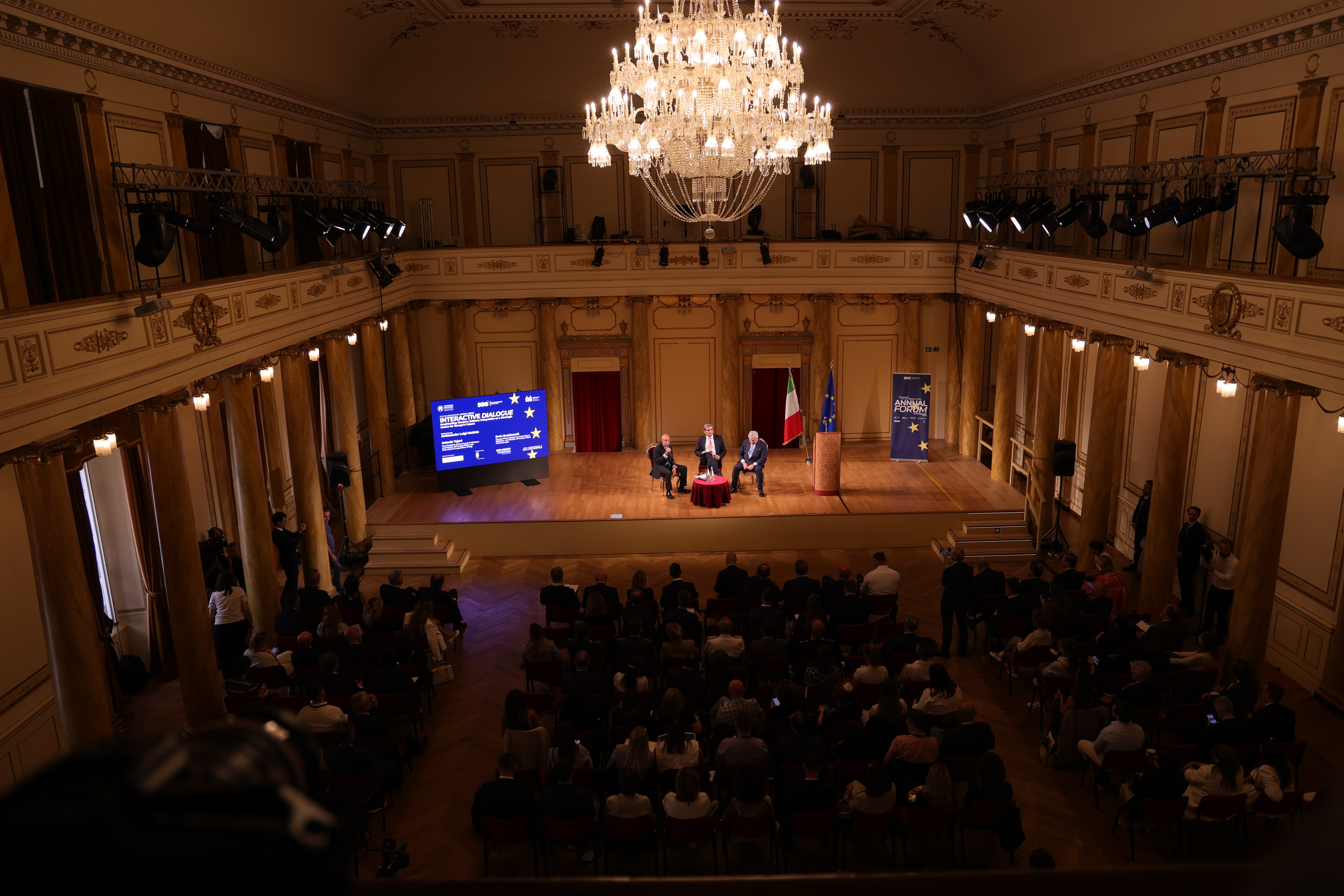
This question was at the heart of the first SEE Observatory Annual Forum, held on 15 September at the Ridotto del Teatro Verdi in Trieste under the title “Accelerating Western Balkans Integration as a Strategic Choice for Europe’s Future.”
The Forum brought together institutional representatives, policymakers, diplomats and younger generations for a discussion that went beyond the accession process itself, addressing the political, security and economic dimensions of Western Balkan integration and its significance for Europe’s future.
The Annual Forum also brought to Trieste the different strands of the SEE Observatory’s work developed throughout 2026. The Liberal Dialogues had taken the debate on Europe’s future across the region, while the SEE Youth Forum, held the previous day at MIB Trieste School of Management, created a space for younger generations to identify shared priorities and develop proposals for future initiatives.
Western Balkan Integration as a European Priority
Opening the Forum, Andrea Cangini, Director of the SEE Observatory and Secretary General of the Luigi Einaudi Foundation, reflected on the purpose behind the Observatory and the work developed during its first year. He recalled the role of the Liberal Dialogues in bringing together hundreds of young people, academics and representatives from across the region, placing the promotion of the European ideal and liberal thought among younger generations at the centre of the Observatory’s mission. For Cangini, accelerating the integration of the Western Balkans represents both a political and strategic imperative for Europe.
The relationship between Trieste, Friuli Venezia Giulia and South-East Europe also emerged strongly during the institutional opening.
Massimiliano Fedriga, President of the Autonomous Region of Friuli Venezia Giulia, described the region – and Trieste in particular – not simply as a bridge towards the Balkans, but as “the bridge of the Balkans towards Europe.” His intervention highlighted the role of people, infrastructure and economic connections in turning institutional integration into a concrete process.
Vladimir Nanut, Founder and CEO of MIB Trieste School of Management and Board Member of the SEE Observatory, recalled the School’s long-standing international vocation and its relationship with Central and Eastern Europe, stressing the importance of combining European values with the skills needed to prepare future generations of leaders.
Franco Dal Mas, Secretary General of the Central European Initiative, also framed the process as one of European reunification rather than simply enlargement, placing younger generations at the centre of this perspective: “Young people are not tomorrow, they are today, and it is today that we build Europe.”
Bringing Young Voices into the Annual Forum
Younger generations also had a direct role in the programme. During the round table “Our Idea of Europe: Young People’s Proposals”, moderated by Eva Ciuk, Scientific Director and Coordinator of the SEE Observatory Scientific Committee, the five winners of the SEE Observatory scholarships shared their vision of Europe and presented their perspectives to the institutional representatives attending the Forum.
Their participation created a direct connection with the SEE Youth Forum held the previous day, where young people and professors representing the countries within the SEE Observatory’s area of interest, alongside a delegation from UWC Adriatic, had worked together to identify priorities, proposals and project ideas for the future of Europe and regional cooperation.
The round table was followed by the Scholarship Award Ceremony, during which the five SEE Observatory scholarships were presented, together with the annual scholarship for the MBA in International Business at MIB Trieste School of Management.
From the First Annual Forum to the Next Phase
A central moment of the Forum was the institutional dialogue moderated by Ambassador Luigi Mattiolo, Honorary President of the SEE Observatory, with Antonio Tajani, Vice President of the Council of Ministers and Minister of Foreign Affairs and International Cooperation of Italy, and Ervin Ibrahimović, Deputy Prime Minister for International Relations and Minister of Foreign Affairs of Montenegro. The Forum also provided an opportunity for the SEE Observatory to present a concrete proposal – the SEE Observatory Charter – aimed at making Western Balkan integration more tangible and credible.
The first SEE Observatory Annual Forum thus brought together the different dimensions of the Observatory’s work in 2026: the regional dialogue developed through the Liberal Dialogues, the involvement of younger generations through the SEE Youth Forum, and the institutional debate on the future integration of the Western Balkans. The ideas and proposals developed throughout this journey now provide a basis for the Observatory’s future activities and for the next edition of the Liberal Dialogues, continuing the conversation across Central and South-East Europe.
Read more about the SEE Observatory Charter and the institutional dialogue on Western Balkan integration in our dedicated article.